For English speakers living in or traveling through Latin America, understanding a medication label is an important practical skill. A few Spanish terms can help you identify what a medicine contains, understand basic instructions, and know when you need help from a pharmacist.
Buying medicine in another country can be surprisingly confusing. You might recognize the medication itself, only to find that the packaging is covered in Spanish, the dosage instructions look unfamiliar, or the product comes in a strength you’ve never seen before.
Here’s what to look for when reading a medication label in Spanish.
Start With the Active Ingredient
One of the most useful things to learn is how to identify a medication’s active ingredient.
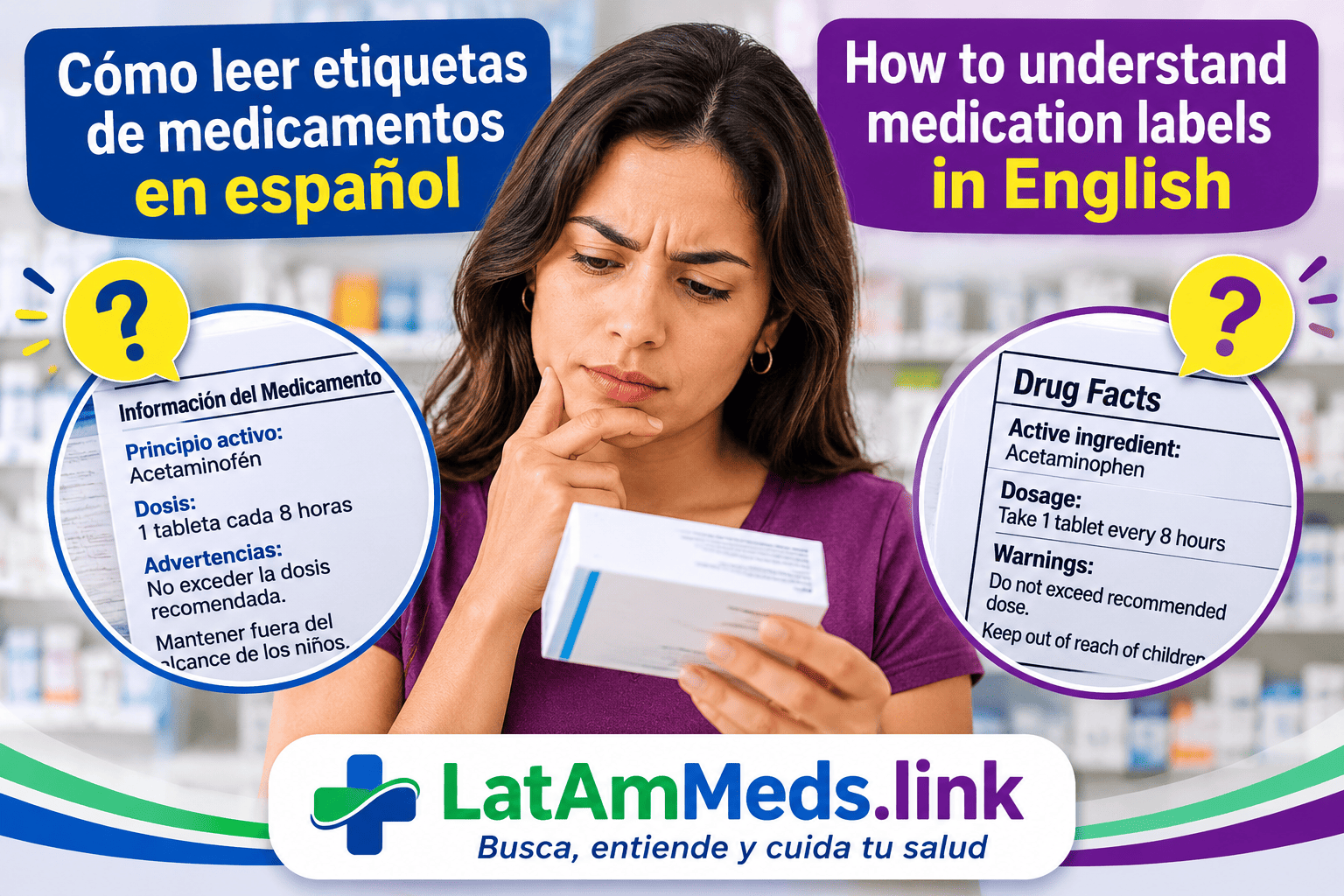
In Spanish, the active ingredient is called the principio activo. You may also see composición, which refers to the product’s composition or ingredients.
The active ingredient is the substance responsible for the medication’s intended effect. For example, acetaminophen, commonly called paracetamol in many countries, is used for pain and fever. Ibuprofen is another familiar example.
Brand names can vary considerably between countries. A product you recognize in the United States might be sold under a different name in Argentina, Mexico, Colombia, or elsewhere. Conversely, two packages with similar names might contain different ingredients.
Looking for the active ingredient is a more reliable starting point than relying on the brand name alone.
Understand the Strength and Dosage
Medication packaging often displays numbers prominently, but it’s important to understand what those numbers mean.
Here are some common terms:
- Dosis: Dose
- Concentración: Concentration or strength
- Miligramos (mg): Milligrams
- Mililitros (mL): Milliliters
- Comprimido or tableta: Tablet
- Cápsula: Capsule
- Jarabe: Syrup
- Gotas: Drops
Suppose a package says 500 mg. That number describes the amount of the specified ingredient in the stated unit, such as one tablet, depending on the product’s labeling. It does not automatically tell you how many tablets to take.
Liquid medications require particular care. A label might list a concentration such as 100 mg/5 mL. This means that five milliliters of the liquid contain 100 milligrams of the specified ingredient.
Don’t confuse milligrams with milliliters. Milligrams measure mass, while milliliters measure volume. They are not interchangeable.
Always check the complete concentration statement and follow the instructions provided by your healthcare professional.
Learn the Most Common Medication Instructions
Spanish medication labels use several recurring expressions. Recognizing them can make a prescription or package insert much easier to understand.
| Spanish | English |
|---|---|
| Vía oral | By mouth |
| Uso externo | External use |
| Cada 8 horas | Every 8 hours |
| Una vez al día | Once a day |
| Dos veces al día | Twice a day |
| Antes de las comidas | Before meals |
| Después de las comidas | After meals |
| Con alimentos | With food |
| Agitar antes de usar | Shake before use |
| No exceder la dosis recomendada | Do not exceed the recommended dose |
| Mantener fuera del alcance de los niños | Keep out of reach of children |
These translations are useful, but they are not a substitute for understanding the full instructions. For example, cada 8 horas describes an interval between doses, while tres veces al día describes a frequency. Those instructions should not automatically be treated as equivalent in every situation.
If the label is unclear, ask a pharmacist to explain the exact schedule before taking the medication.
Pay Attention to Warnings and Precautions
Medication labels and package inserts often include warnings that are just as important as the dosage instructions.
A few useful terms include:
- Advertencias: Warnings
- Precauciones: Precautions
- Contraindicaciones: Contraindications
- Efectos secundarios: Side effects
- Reacciones adversas: Adverse reactions
- Interacciones: Interactions
- Alergia: Allergy
- Embarazo: Pregnancy
- Lactancia: Breastfeeding
You might also see somnolencia, meaning drowsiness, or mareos, meaning dizziness.
These words can alert you to information that deserves closer attention. They do not tell you whether a particular warning applies to you personally, however. That depends on the medication, your circumstances, and any other medicines you take.
If you’re unsure whether a warning applies to you, ask a pharmacist or healthcare professional before using the product.
Check the Expiration Date and Storage Instructions
Expiration dates and storage conditions matter, particularly in hot climates.
Look for these terms:
- Fecha de vencimiento or fecha de caducidad: Expiration date
- Lote: Batch or lot number
- Conservar en un lugar fresco y seco: Store in a cool, dry place
- Proteger de la luz: Protect from light
- Refrigerar: Refrigerate
- No congelar: Do not freeze
Not every medication should be refrigerated. Some need protection from heat or moisture, while others have specific temperature requirements.
If a medicine has been exposed to excessive heat, stored incorrectly, or left in a hot vehicle, ask a pharmacist whether it remains suitable for use. Don’t assume that an unexpired product is necessarily in good condition.
Don’t Assume Two Medicines Are Equivalent
Recognizing a familiar ingredient is helpful, but it isn’t enough to establish that two products can be substituted safely.
Medicines may differ in strength, formulation, route of administration, and release characteristics. For example, a tablet designed to release its ingredient gradually may not be interchangeable with an immediate-release tablet, even if both contain the same active ingredient.
Combination products create another potential problem. One product may contain a single ingredient, while another contains several. Taking both without checking their composition could result in accidentally doubling an ingredient.
If you cannot find your usual medication, show the packaging or prescription to a local pharmacist. Ask them to confirm the active ingredients, strength, formulation, and appropriate instructions. If the medicine requires a prescription, follow the local prescribing requirements rather than substituting it yourself.
When a Translation Isn’t Enough
A translation tool can help you understand individual words, but medication instructions sometimes depend on context. A mistranslated abbreviation, an unclear concentration, or a misunderstood dosing interval can have real consequences.
If you have a prescription, keep a copy of it and the original medication packaging when possible. These can help a pharmacist identify the product you normally use.
You can also learn the Spanish names of your regular medications before traveling. Knowing both the brand name and active ingredient makes it easier to explain what you need if the packaging looks different abroad.
Most importantly, don’t guess when an instruction is unclear. A pharmacist can help interpret the label and determine whether a product is appropriate for your situation.
A Little Preparation Goes a Long Way
You don’t need to become fluent in Spanish to navigate a pharmacy more confidently. Learning a handful of common medication terms, recognizing active ingredients, and knowing how to check strength and expiration dates can make a meaningful difference.
When you encounter an unfamiliar product, start with the active ingredient, read the concentration carefully, and check the instructions and warnings. If anything remains uncertain, ask a qualified professional before taking it.
Understanding what’s written on a medication label is a useful first step toward using medicines safely, especially when you’re far from home.
LatAmMeds.link helps English- and Spanish-speaking users navigate medication names across languages and countries. It is an informational resource, not a substitute for professional medical advice or confirmation that two medications can be safely substituted.