Many people from the United States who travel to Latin America, or move there, get a surprise at the pharmacy. They ask for a medicine they expect to need a prescription for, and the person at the counter simply hands it over. Other times it goes the other way, and a medicine that seemed easy to get turns out to have strict rules.
Both experiences are common. This article explains how pharmacies usually work across Latin America, why the system feels so different, and what to know to stay safe. Every country has its own laws, so think of this as a general guide.
What a pharmacy visit looks like
In many Latin American cities, there is a pharmacy on almost every block. Some are small family businesses. Others are big chains, like Farmacias del Ahorro and Farmacias Guadalajara in Mexico, Cruz Verde in Colombia and Chile, or Farmacity in Argentina.
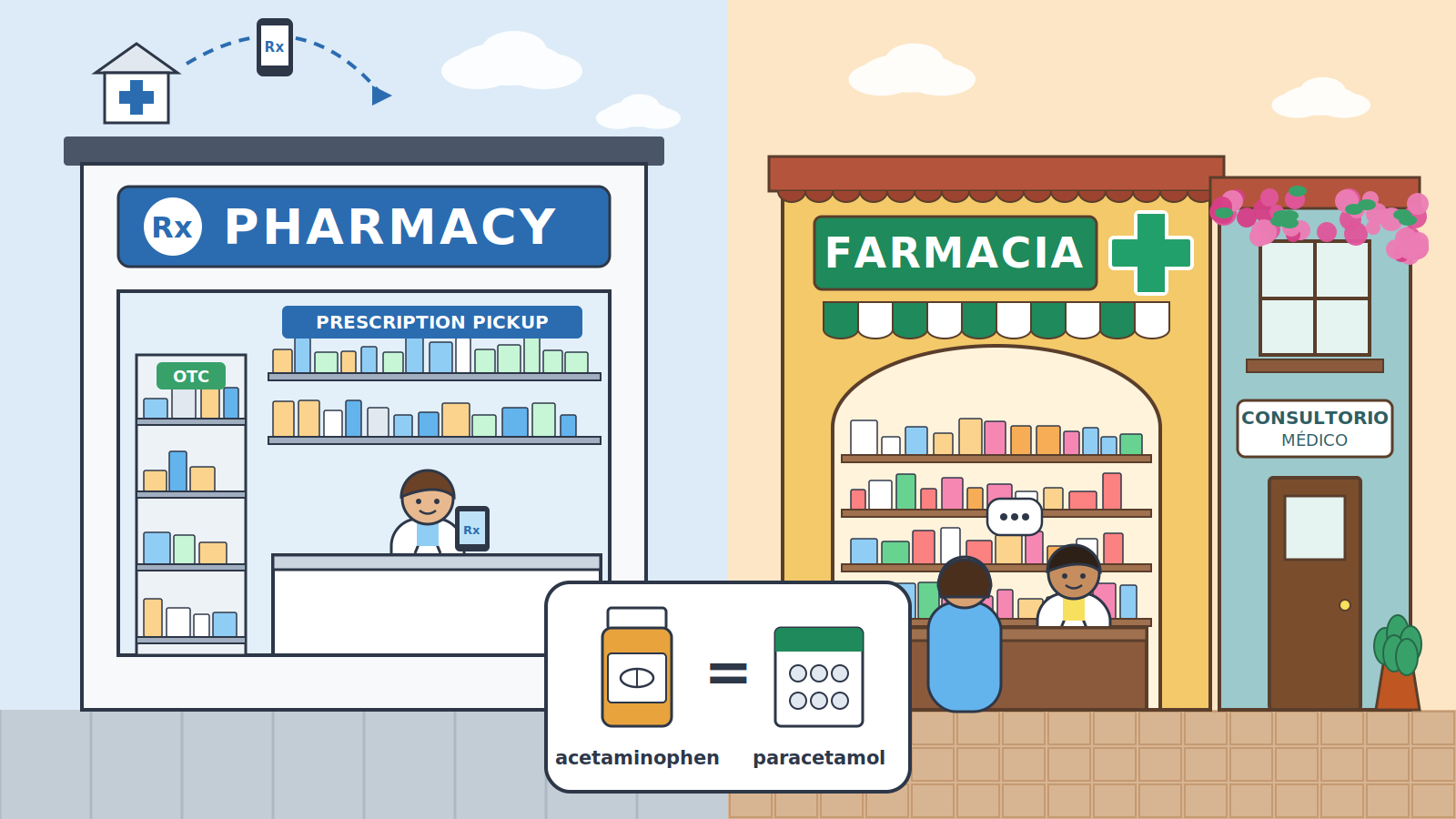
In many of them, the medicines sit behind the counter. You tell the person at the counter what you need, and they bring it to you. Walking the aisles and picking things up yourself, like at CVS or Walgreens, is less common.
Many pharmacies, especially in Mexico, have a small doctor’s office right next door. A basic visit there usually costs very little, and the doctor can write a prescription on the spot.
Pharmacy staff are also used to giving advice. It is normal to describe a problem, like a sore throat or an upset stomach, and ask what they recommend. Keep in mind that the person at the counter is not always a trained pharmacist.
The rules on paper and the rules in practice
Most Latin American countries have laws that say many medicines need a prescription. Antibiotics are a good example. Mexico has required a prescription for antibiotics since 2010, and many other countries have similar rules.
How closely those rules are followed depends on the country, the city and even the pharmacy. Large chains in big cities tend to follow them more closely. Small pharmacies in some areas may be more flexible.
There is one group of medicines with strict rules almost everywhere: controlled medicines. This includes strong pain medicines, many medicines for anxiety and sleep, and medicines for ADHD. These usually need a special prescription from a local doctor, and some are hard to find at all.
Why the system works this way
In many places, seeing a doctor takes time and money that not everyone has. Over the years, the neighborhood pharmacy became the first stop for everyday health problems. People trust it the way they would trust a family doctor.
That easy access has real benefits. Care is fast, close to home and usually cheap.
The U.S. system puts control first. It is slower and often more expensive, but it is built to catch mistakes and dangerous mixes of medicines.
Neither system is perfect. They are two different ways of getting medicine to people.
Same medicine, different name
This is where many visitors get confused. Brand names in Latin America are often different from the ones in the United States. A medicine called one thing at Walgreens may have a completely different name on a shelf in Bogotá or Lima.
The active ingredient is what matters. For example, the active ingredient in Tylenol is called acetaminophen in the United States, but in most of Latin America it is called paracetamol. Same medicine, different word.
Doses can be different too. A pill in one country may be stronger or weaker than the one you are used to. Read the box or ask before taking it.
Many pharmacies also sell generic versions. These have the same active ingredient as the brand name and cost less.
Your U.S. prescription abroad
A prescription from a U.S. doctor usually has no legal value in another country. Some pharmacy staff may look at it as a guide, but for a medicine that needs a prescription, the safest path is to see a local doctor.
U.S. telehealth services usually can’t help much either. Most U.S. doctors can only treat you by video while you are physically in a state where they have a license.
If you take medicine every day, the easiest plan is to bring enough for your whole trip. Keep it in the original containers, with a copy of your prescription.
Some medicines that are common in the United States, like certain ADHD or strong pain medicines, have strict rules in other countries. Check with the embassy or the health ministry of the country you are visiting before you pack them.
Planning to bring medicine back to the United States? There are rules about how much and what kind. Check with U.S. Customs and Border Protection before you buy.
Practical tips
Learn the active ingredient names of the medicines you take. Write them down, along with the dose. This one habit solves most problems at the counter.
Carry a short list of your medicines and allergies, in English and in Spanish (or Portuguese for Brazil). It helps at the pharmacy, and even more in an emergency.
Buy from established pharmacies. Check that the box is sealed and look at the expiration date.
When in doubt, see a local doctor. In many cities, private clinics can see you the same day, and the cost is often much lower than in the United States.
Check your health insurance before you travel. Medicare usually does not cover care outside the United States, and many private plans cover very little. Travel health insurance can fill that gap.
With antibiotics, even when you can buy them without a prescription, a quick doctor visit helps you get the right one. The wrong antibiotic, or stopping too early, can make the next infection harder to treat.
Emergency numbers are not the same in every country. Look up the local number before you arrive and save it in your phone.
Final thoughts
Buying medicine in Latin America is often easier and cheaper than in the United States, but that doesn’t mean anything goes. Knowing the active ingredient, reading the box and asking questions will make almost every pharmacy visit simple.
Have a question about a specific medicine or country? Leave it in the comments.
More guides are coming soon on LATAM Meds, including how to find a doctor while traveling and how medicine names change from country to country.