Imagine you’re in traveling in Latin America and need a medication you take regularly at home. You know its name in English, but the pharmacist doesn’t recognize it. You describe it, maybe show a photo of the bottle, and you’re still not sure you’re getting the right thing.
This happens all the time to travelers and expats. The medicine you need is often available, just under a different name. The hard part is confirming that what’s on the shelf matches what you take at home.
Two names worth knowing
Most medications have a brand name, which the manufacturer uses to market it, and a generic name, which identifies the active ingredient.
Brand names are the less reliable of the two. Omeprazole is sold as Prilosec in the U.S. but as Losec in many other countries. A drug may also be sold under a local brand you’ve never heard of, or simply as a generic with the ingredient name on the box.
Generic names travel better, but not perfectly. Most look similar in English and Spanish (ibuprofen/ibuprofeno, amoxicillin/amoxicilina), but a few are different enough to cause confusion:
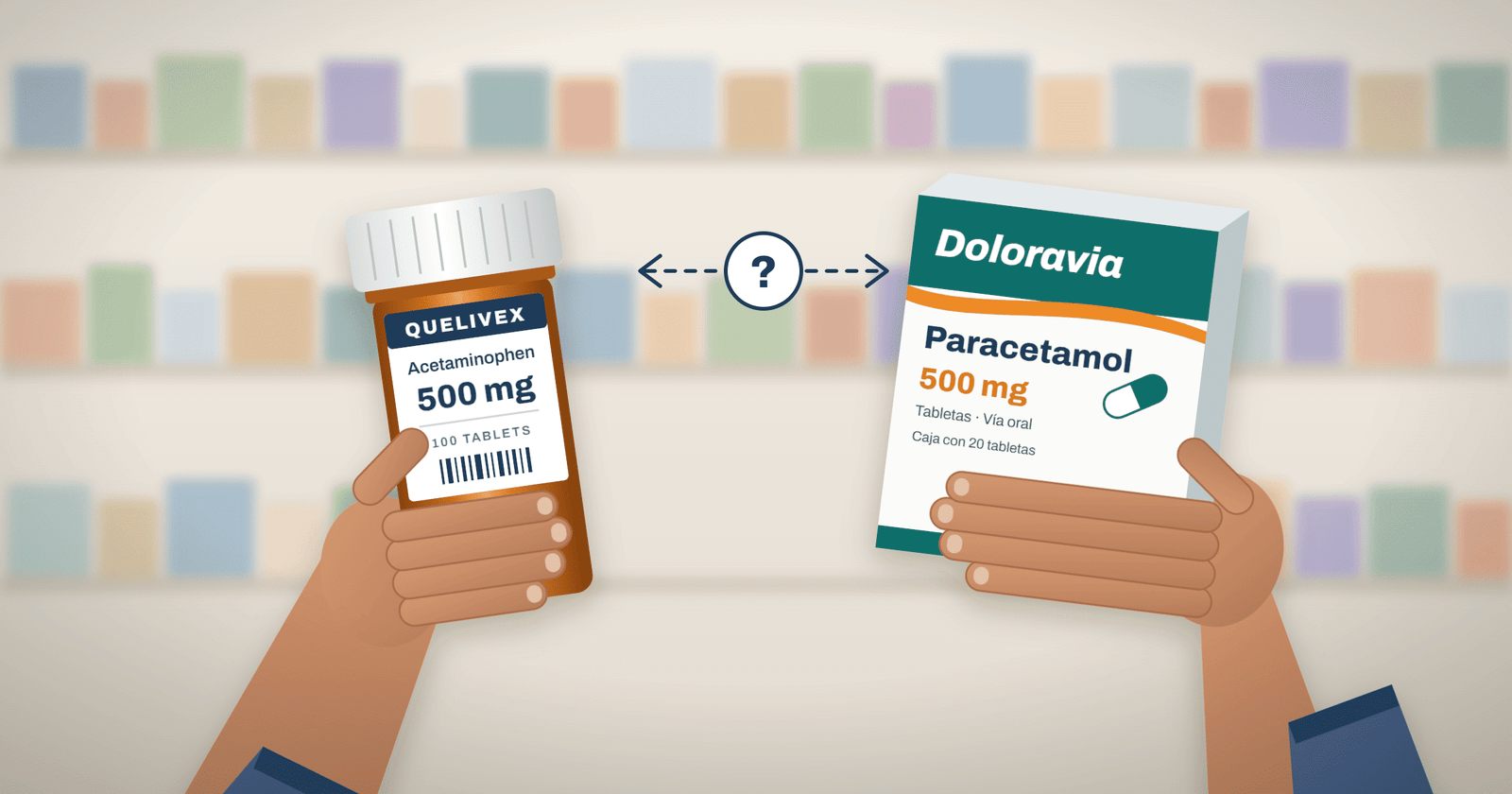
- Acetaminophen is paracetamol in Latin America
- Albuterol is salbutamol
- Glyburide is glibenclamida
- Epinephrine is often called adrenalina
If you learn one thing before you travel, make it the generic name of everything you take.
Why the same medicine isn’t always on the shelf
Even when you know the right name, you might not find an exact match. Manufacturers don’t sell the same product lineup in every country, and each country has its own approval process. A drug common in the U.S. may not be marketed locally at all, while some products sold over the counter in Latin America, such as metamizole (dipirona), aren’t approved in the U.S.
Prescription rules differ too. Something you buy freely at home may require a receta médica abroad, and vice versa.
Matching the name isn’t enough
Finding the right active ingredient is only the first step. Before treating a local product as a substitute, compare these on the package:
Strength. Look for the amount of active ingredient per unit, often listed after “Cada tableta contiene…” A 250 mg tablet isn’t a 500 mg tablet. Keep in mind that strength (what’s in each pill) is different from dose (how much you take), and the box won’t tell you your dose.
Form. Tablet, capsule, syrup (jarabe), drops (gotas), cream, or injection. The same ingredient can be made for very different uses.
Release type. Extended- and delayed-release versions aren’t interchangeable with regular ones. In Spanish, watch for liberación prolongada, liberación retardada, or abbreviations like LP or “retard” on the box.
Other ingredients. Cold and flu products in particular often combine several active ingredients, and the combinations vary by brand and country. This matters if you’re already taking something else.
What doesn’t help: packaging, color, or shape. Latin American pharmacies usually sell medication in boxes of blister packs rather than bottles, and a pill’s appearance tells you nothing about whether it’s equivalent.
How to get it right at the pharmacy
- Bring your original packaging or prescription, or a clear photo showing the ingredient and strength.
- Ask for the medicine by its generic name.
- Compare ingredient, strength, form, and release type against what you use at home.
- If anything differs, or if it’s a prescription drug you shouldn’t stop or change on your own, ask the pharmacist or your doctor to confirm it’s suitable before you take it.
Pharmacists in Latin America are generally used to helping customers compare products, so don’t hesitate to ask.
Finding the name in the other language
The language barrier works both ways. English speakers struggle at pharmacies in Guatemala or Mexico, and Spanish speakers face the same problem in the U.S. LatAmMeds.link lets you look up medication names between English and Spanish so you know what to ask for. Just head back to the homepage and search.
A name lookup gets you to the right product; checking the label and talking to a pharmacist confirms it’s the right medicine for you.