A medical emergency is stressful anywhere in the world. When it happens while traveling, the situation can feel even more overwhelming—especially when the healthcare system, language, customs, and expectations are different from what you know at home.
For travelers from the United States, seeking medical care in Latin America can involve some unfamiliar experiences. However, there is no single “Latin American healthcare system.” Mexico, Guatemala, Colombia, Peru, Argentina, Brazil, Costa Rica, and other countries all have their own healthcare systems, regulations, hospitals, and customs.
The goal of this article is therefore not to describe one universal system, but to highlight some of the differences a U.S. traveler may encounter and the questions worth asking before and during an emergency.
First: Don’t Assume Every Country Works the Same Way
One of the most important things to understand is that Latin America is not one healthcare system.
The experience of going to an emergency department in a major private hospital in Mexico City may be very different from seeking care in a public hospital in a smaller city in Guatemala or Peru.
There can also be substantial differences between:
- Public and private healthcare facilities.
- Large cities and rural areas.
- Tourist destinations and areas with fewer medical resources.
- Hospitals and smaller clinics.
- Countries, and sometimes even regions within the same country.
For this reason, information from another traveler about their experience may not accurately predict what will happen where you are.
Where Do You Go in an Emergency?
In the United States, most people are familiar with the concept of going to an Emergency Department (ED) or Emergency Room (ER).
In Latin America, you may encounter several different terms for emergency care.
Depending on the country, you might see:
- Emergencias
- Urgencias
- Servicio de Emergencia
- Pronto Socorro in Portuguese-speaking countries such as Brazil.
The exact terminology varies.
You may also encounter private clinics, hospital emergency departments, urgent-care-type facilities, or smaller medical centers.
If you are in a hotel or tourist area, hotel staff, tour operators, or local contacts may know which nearby facility commonly treats international visitors. In a serious emergency, however, seek emergency assistance rather than relying solely on recommendations based on convenience.
Public and Private Care Can Be Very Different
One of the biggest differences a U.S. traveler may encounter is the distinction between public and private healthcare.
Many Latin American countries have public healthcare systems as well as private hospitals and clinics. The availability, resources, waiting times, payment arrangements, and patient experience can differ considerably between them.
Private hospitals in major cities and tourist destinations may have internationally trained physicians, modern diagnostic equipment, English-speaking staff, and services specifically designed for international patients.
That does not mean that private care is automatically “better,” nor does it mean that public facilities cannot provide excellent emergency care. The circumstances vary greatly.
For a traveler, however, knowing whether you are entering a public hospital, private hospital, or clinic can help you understand what to expect.
Payment May Be Discussed Earlier Than You Expect
One difference that can surprise U.S. travelers is how and when payment is handled.
In the United States, patients are accustomed to providing insurance information and receiving bills related to their care. In Latin America, the process can vary considerably.
A private facility may ask about:
- Insurance.
- A credit card or other payment method.
- A deposit.
- Authorization from an insurance company.
- Whether you are paying privately.
In some situations, the hospital may require payment or financial authorization before certain non-emergency services are provided.
This is one reason travel medical insurance can be extremely valuable.
Travel insurance is not the same as your regular U.S. health insurance
Before traveling internationally, check what your U.S. health insurance actually covers outside the United States.
Do not assume that because you have comprehensive health insurance at home, all medical treatment abroad will automatically be covered in the same way.
Travel medical insurance or other international coverage may provide benefits that your regular domestic plan does not.
If you have travel insurance, keep the assistance phone number and policy information accessible—not buried in an email account you cannot access easily.
Your U.S. Insurance Card May Not Be Enough
A U.S. insurance card may be useful, but it does not necessarily function like a local insurance card.
A hospital in another country may need to contact your insurer or travel-assistance company to determine whether care can be covered.
You may be asked to pay directly and seek reimbursement later.
If that happens, keep:
- Receipts.
- Medical bills.
- Discharge documents.
- Prescriptions.
- Test results.
- Imaging reports.
- Any documentation describing your diagnosis and treatment.
These documents can become important when communicating with your insurer or a physician after returning to the United States.
Language Can Become a Medical Issue
A language barrier is more than an inconvenience during a medical emergency.
You may need to explain:
- Where it hurts.
- How severe the pain is.
- When symptoms began.
- What medications you take.
- Whether you have allergies.
- Whether you have had previous medical problems.
- What happened immediately before the emergency.
If you speak some Spanish or Portuguese, that can help—but medical vocabulary can be surprisingly difficult even for people who are conversationally fluent.
For example, knowing how to order food in Spanish does not necessarily mean you know how to explain that you are experiencing shortness of breath, dizziness, numbness, or abdominal pain.
If you are traveling to a country where you do not speak the language, consider learning a small set of medical phrases before your trip.
Don’t Rely Entirely on a Translation App
Translation apps can be extremely useful, particularly when no other option is immediately available.
But medical communication can involve details that are easy to misunderstand.
For example, there is a major difference between:
- “I am allergic to penicillin.”
- “I think penicillin made me feel sick once.”
Similarly, saying that you take a medication “for blood pressure” may not be enough. The medical team may need the medication’s exact name, dose, and frequency.
If possible, keep a written medical summary in your phone in both English and the local language.
A useful summary might include:
Medical conditions:
Asthma, diabetes, high blood pressure, etc.
Medications:
Generic name, dose, and frequency.
Allergies:
Medication or food allergies and the reaction.
Emergency contact:
Name and phone number.
This can be especially helpful if you are too ill or injured to explain everything yourself.
Medication Names May Be Different
Medication is another potential source of confusion.
A drug that you know by a particular brand name in the United States may be sold under a different brand name—or only under its generic name—in another country.
For this reason, travelers should know the generic names of their medications whenever possible.
For example, instead of carrying only a bottle labeled with a U.S. brand name, consider keeping a list containing:
Generic name + strength + dose + frequency.
This information can be much more useful to a physician or pharmacist in another country.
Do not assume that a medication available over the counter in one country has the same status in another.
You May Encounter Different Healthcare Roles
The healthcare professionals you encounter may have different titles, responsibilities, and scopes of practice from those you are familiar with in the United States.
You may interact with:
- Médicos / physicians.
- Enfermeros / nurses.
- Técnicos / technicians.
- Farmacéuticos / pharmacists.
- Especialistas / specialists.
- Other healthcare professionals.
The organization of the healthcare team can vary by country and facility.
If you are unsure who is caring for you, it is reasonable to ask:
“What is your role?”
or, in Spanish:
“¿Cuál es su función?”
Understanding who is speaking with you can make communication easier.
The Patient–Provider Relationship May Feel Different
Cultural expectations around healthcare can vary.
Some U.S. patients are accustomed to a relatively informal relationship with healthcare professionals and may expect extensive discussion of treatment options.
In other settings, communication may feel more formal or more hierarchical.
You may also encounter differences in:
- How directly bad news is communicated.
- How much information is given at once.
- How family members participate in decisions.
- How much time a clinician spends explaining a diagnosis.
- How comfortable patients are asking questions.
These differences do not necessarily indicate that one approach is better than another. They reflect different medical cultures and systems.
If you do not understand something, ask.
Useful questions include:
“What is the diagnosis?”
“What tests are you doing?”
“What is this medication for?”
“Are there any side effects I should know about?”
“Do I need to stay in the hospital?”
“What should I do if my symptoms get worse?”
Family Members May Play a Different Role
In many Latin American cultures, family involvement in healthcare can be particularly important.
You may see relatives much more involved in communication, decision-making, transportation, or practical aspects of a patient’s care.
This can feel different from what a U.S. traveler expects.
At the same time, privacy and confidentiality still matter. If you want a family member or travel companion involved in discussions about your care, let the healthcare team know.
If you are traveling alone, having an emergency contact who can be reached by phone can be particularly valuable.
Medical Records May Not Follow You Automatically
In the United States, many healthcare systems use electronic medical records that allow different clinicians within the same network to access a patient’s information.
When traveling internationally, you should not assume that a hospital in Latin America will have access to your U.S. medical records.
The physician treating you may know nothing about your previous medical history unless you provide it.
This makes it particularly useful to carry important information yourself.
Consider keeping a concise medical record containing:
- Major medical conditions.
- Previous surgeries.
- Allergies.
- Current medications.
- Recent major diagnoses.
- Relevant laboratory results.
- Contact information for your physicians.
- Insurance and travel-assistance information.
Keep a copy on your phone and, if practical, another accessible backup.
Emergency Transportation May Work Differently
Emergency medical transportation also varies significantly between countries and locations.
In some places, ambulance services may be readily available. In others, response times, coverage areas, equipment, staffing, and coordination with hospitals may differ.
Do not assume that calling an ambulance abroad will produce exactly the same type of response you would expect in the United States.
Before traveling, it can be useful to know the local emergency number.
For example, 911 is used in some Latin American countries, but emergency numbers are not universal across the region.
Your hotel, host, travel company, or local contact may also be able to help identify the appropriate emergency service.
Pharmacies May Play a More Visible Role
Travelers from the United States may notice that pharmacies and pharmacists can have a different role in everyday healthcare in Latin America.
Depending on the country and medication, travelers may encounter medicines that are available through pharmacies under different rules than they are in the United States.
However, availability does not necessarily mean that a medication is appropriate for your condition.
Do not assume that because you can obtain a medication without a prescription in another country, it is safe to self-treat a potentially serious condition.
For an actual emergency, a pharmacy is not a substitute for appropriate emergency medical evaluation.
Ask for Your Medical Documentation Before You Leave
If you receive emergency treatment while abroad, ask what documentation you can take with you.
Depending on the situation, this might include:
- Diagnosis.
- Discharge summary.
- Laboratory results.
- Imaging reports.
- Medication list.
- Prescriptions.
- Follow-up recommendations.
- Copies of important imaging, when available.
If the documentation is in Spanish or Portuguese and you will need to show it to a U.S. healthcare provider later, having a translation may be useful.
Keep the original documentation whenever possible.
If You Are Hospitalized
Being admitted to a hospital in another country can be particularly stressful.
If hospitalization becomes necessary, ask:
“How long do you expect me to stay?”
“What is the diagnosis?”
“What treatment am I receiving?”
“Who should my insurance company or travel assistance provider contact?”
“Can my family or emergency contact be notified?”
If you have travel insurance, contact the assistance service as soon as reasonably possible. They may be able to help with communication, locating appropriate facilities, coordinating payment or authorization, and arranging other assistance.
If you are too sick or injured to handle these matters yourself, your travel companion or emergency contact may need to help.
Before You Travel: A Simple Medical Preparation Checklist
You do not need to prepare for every possible medical emergency. A few simple steps can make a significant difference.
Before leaving the United States, consider having:
Medical information
- A list of your medications.
- Generic medication names.
- Medication doses.
- Allergies and reactions.
- Important medical conditions.
- Major surgical history.
- Emergency contact information.
Insurance information
- Health insurance information.
- Travel medical insurance information, if applicable.
- International assistance phone numbers.
- Information about evacuation or repatriation coverage, if included in your policy.
Communication
- The local emergency number.
- The address of your hotel or accommodation.
- A short medical summary in the local language.
- A translation app available offline, when possible.
Documents
- Passport or other identification.
- Insurance information.
- Copies of important medical documents.
A Few Phrases Worth Knowing
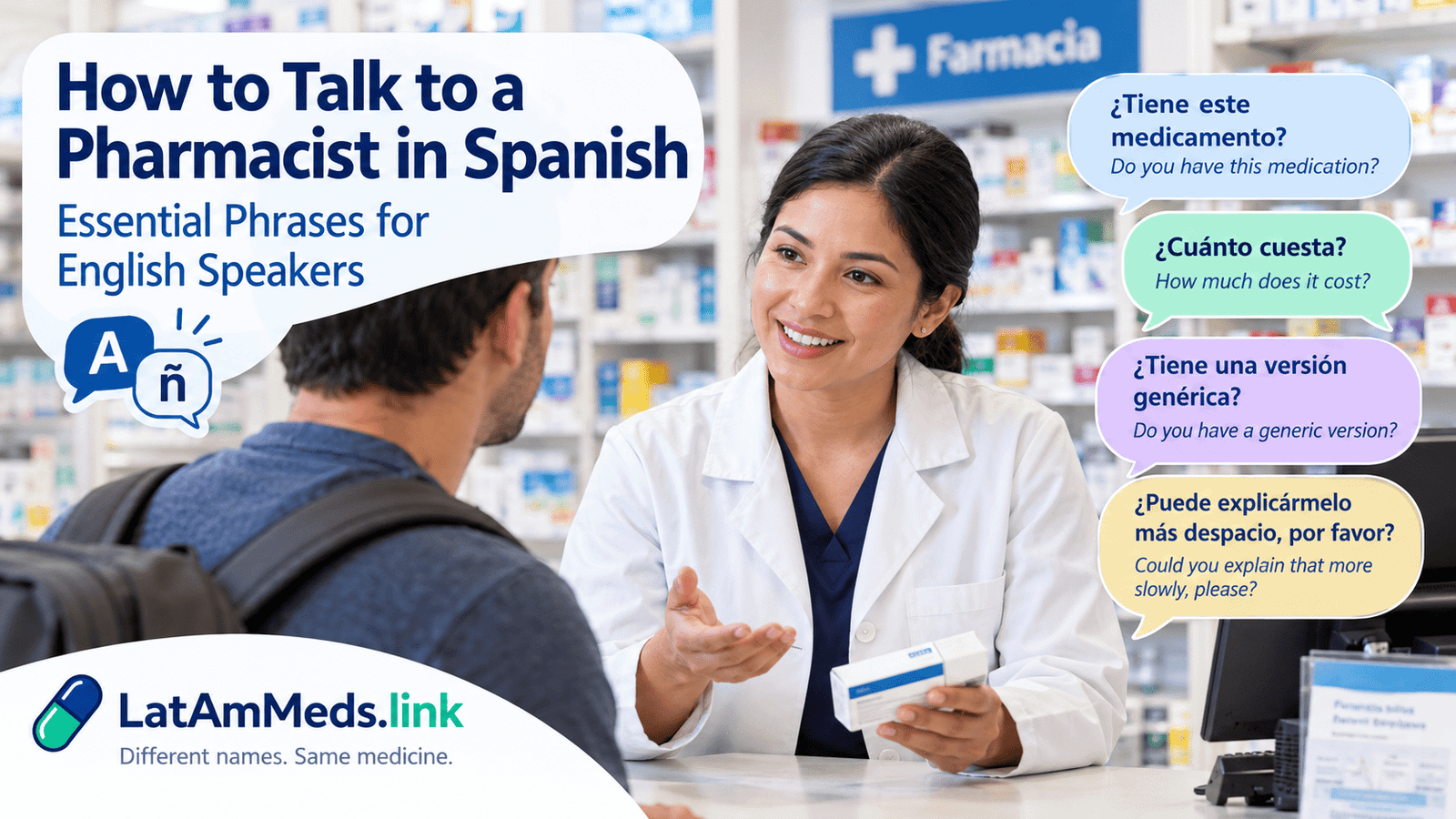
If you are traveling in a Spanish-speaking country, these phrases can be useful:
English| Spanish
I need medical help.| Necesito ayuda médica.
I need to go to the emergency department.| Necesito ir a emergencias.
I am having trouble breathing.| Tengo dificultad para respirar.
I have chest pain.| Tengo dolor en el pecho.
I am allergic to this medication.| Soy alérgico/a a este medicamento.
I take this medication every day.| Tomo este medicamento todos los días.
I have diabetes.| Tengo diabetes.
I have high blood pressure.| Tengo presión arterial alta.
Where is the nearest hospital?| ¿Dónde está el hospital más cercano?
Do you speak English?| ¿Habla inglés?
I need an interpreter.| Necesito un intérprete.
What is this medication for?| ¿Para qué sirve este medicamento?
When should I come back?| ¿Cuándo debo regresar?
The Most Important Thing to Remember
A medical emergency is not the time to compare one country’s healthcare system with another.
The most important priorities are to get appropriate care, communicate your symptoms and medical history clearly, understand what is happening, and make sure you know what to do next.
For U.S. travelers in Latin America, being prepared for differences in language, payment, healthcare facilities, documentation, and medical culture can make an unfamiliar situation easier to navigate.
Know your own medical information, understand your insurance or travel coverage, learn a few important phrases, know how to seek local emergency assistance, and be prepared to ask questions.
When you’re far from home, a little preparation can make a difficult medical situation much easier to navigate.